Sunday, March 18, 2018

#2072 "March Sunset Ice on Fire"

I never get tired of the Singleton sunsets. Every sunset is different. The sky, the clouds and the lake are big variables that always keeps things different. The palette and the type of the painting surface are also big variables to be reckoned with. The position of the setting sun was progressively moving northward every day. The sun pillar in the painting showed that on March 4th, 2017 the sun was setting behind the forest on Point Paradise of Singleton Lake.
The subtle banding in the altostratus clouds was the result of the deformation zone process and not gravity waves and strong winds aloft. Singleton Lake was sandwiched between two very large storms and equally extensive deformation zones. This cloud was the hang back from the storm over the eastern seaboard. Some of the thicker bands of altostratus produced snow virga. The virga diffused and softened the banding in the bottoms of the middle cloud. Not a flake reached the ground at Singleton Lake. The skies were clear on the distant horizon.
I used a lot of paint on this slippery and smooth surface. It was fun as art should be.
 For this and more art, visit Pixels.com

Saturday, March 17, 2018

#2071 "Tuesday Sunset"

I had some time to paint. This was the sunset from Tuesday January 16th, 2018. Ontario was in the midst of a cold spell with fresh Arctic air being directed southward fresh from the North Pole. At one time the open water of Jim Day Rapids could be measured by just a few square metres. The flat and wavy tops and bottoms of the altostratus cloud revealed the strong northerly winds. Even the colours were cold.
The inclusion of Tuesday in the title was meant to be a bit humourous since the day of the week has nothing to do with the appearance of the sunset. The month might give the season away and reveal a bit about what type of sky to expect. Regardless I thought that the sunset was beautiful and this led me to think of the old rythme about Tuesday's child being full of grace. I had fun with lots of oil on the slippery surface. The surface type greatly influences the feel of the oils.

At one time I signed my name large like my mentor Mario Airomi. Over the years I have changed that so that my signature is only an inconspicuous portion of the art... often scratched in the thick and wet oils with a stick, tooth pick or nail. The art really needs to be more about the quality than the signature... just my opinion though.
 For this painting and more art as well...

Friday, March 16, 2018

#2066 "Behind the January Cold Front"

It was a shallow Arctic cold front with only some cloud along it. There was also some snow virga but nothing much made it to the ground at least around Singleton Lake. The cold air advection winds aloft wwere sufficient to make some rolls in the tops of the cloud deck. These backward curls always attract my eye. There was no cloud above the stratocumulus and in a few hours it would be clear within the cold and clean Arctic air.

I like to capture the optics of the reflections. The sun breaking through between the streets of turbulent stratocumulus reflected brightly in the calm and open water at the head of Jim Day Rapids. One can see that the reflected tops of the trees are bordered by the direct reflection of this sunlight. When one looks straight at the western shore of Singleton Lake the next street of stratocumulus to the west provides the backdrop to the Singleton Lake forest. The optics of the different viewing angles always interests me. If you paint what you see, you must be correct even if you do not bother to solve the science and angles behind it.
For you weather enthusiasts the water vapour imagery holds the answers to all of your questions behind this sunset scene.

I made a promise to the widow of an artist friend to turn these panels that he had prepared into paintings. This is another of those very rough panels. I still have a few left. They are very hard on my brushes but that is life in the fast lane.
 For this painting and much more...

Thursday, March 15, 2018

#2068 "Mattawa Outward Bound"

Very wet paint...

This is based on #1788 "Mattawa Morning". Seven modern, white water canoes were following the down-current path of the historical voyageurs in early June 2016. There was lots of water to make the rapids passable. The boulder fields at the low water outlet of the rapids did provide a few obstacles but we made it through unscathed. Two hundred years ago there would have been much more traffic on this water highway. It would have been the only route into the heart of the new land. We were virtually alone in 2016.
It had rained hard the previous night but cold air mass stratocumulus and remnants of fog and stratus were a welcome shield from the blazing sun of the previous few days. My goodness, this was a fun trip that was full of irreplaceable memories. I just had to record it in oil only hoping that some of the feelings would make it into the pigments. Art is more than tone, colour and shapes. You need to get the rhythm and emotion into the brush strokes which is something that the camera has a challenge with.
Started 2 pm Friday February 2nd, 2018 - Ground Hog Day and I did see my shadow. It was sunny outside but the cold northwesterly winds and the resulting windchill countered the effects of the direct radiation. I was looking for a happy memory to enlarge. Perhaps the joy of a small panel can be made raptuorous when turned into something big. I had just set #2067 "Big Joe Mufferaw Pines" aside so I was in the Mattawa groove. I just stumbled across this pleasant memory. It must have ben destined to happen. It certainly was not planned. Cross your fingers and your paddles.

Outward Bound is an organization with the mission to cultivate resilience, leadership, connections and compassion through inspiring and challenging journeys of self-discovery in the natural world. They were active when I was in university and I wish that I had participated in some of their canoe trips. It is never too late.
 For this painting and much more...

Monday, March 12, 2018

#2069 "Flooded Land Wood Duck Drake"

Very wet painting just off the easel...

I have several trail cameras around the Singleton property. It is interesting to see what is enjoying the forest and lakes with us. This particular camera was set about four feet above the ground on a trail that I suspected was frequented by the bobcat and wolf. I was even hoping to get a glimpse of the cougar that was reputed to be in the area. The spring flood of 2014 almost drowned the camera. I did manage to get some nice images of some very relaxed and content ducks. This wood duck drake was probably born in one of the twenty wood duck houses that are scattered around the wetlands.
The flooded wetland floated several large logs and changed the landscape for a while. Ducks, turtles, frogs and a host of other creatures used these logs to bask on.

I used a lot of paint on this particular canvas.

 Click to go to Chadwick Art... Thank you!


Sunday, March 11, 2018

#2070 "Happy Place"

This is very wet off the easel...
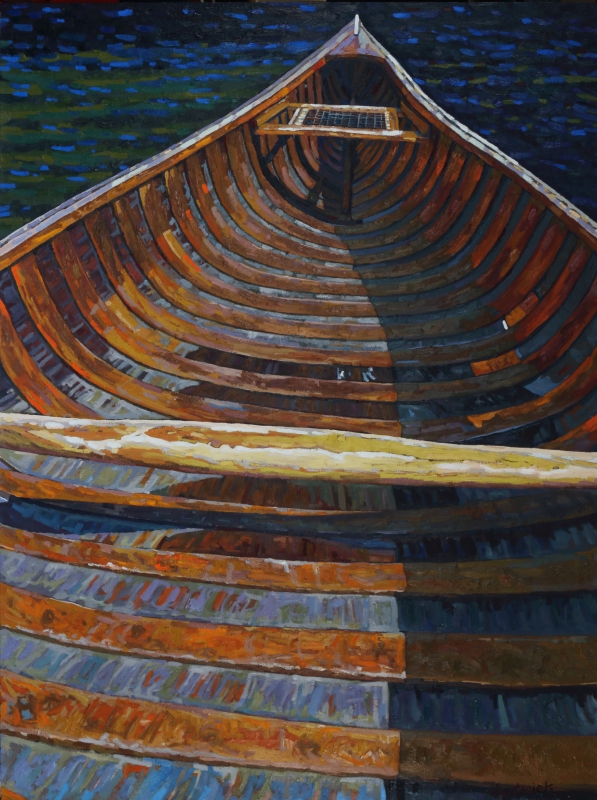
This is a large version of #1826 "Stern Seat". I was working very hard on #2069 "Flooded Land Wood Duck Drake" and worried about stroking it to death. The best way to avoid overkill is to just start another canvas. I had this idea waiting in the wings and plus it was spitting rain outside on a winter day. It is an unusual composition and sadly beyond the experience of many. I am hoping that it connects with a few and that is enough for me.

Let me explain the title. I am not fond of injections or needles. I don't "cry" but I do go to my "Happy Place" which is the stern seat of my canoe. The location of the specific waterway in my mind's eye doesn't really matter but I certainly do have my favourites. From the stern seat I can paddle the canoe silently almost anywhere and you would be amazed at what you can find and see along the way.

This old canoe leaked when I put it in the water. My carbon "Margaritaville" canoe was on top of the car but it was a privilege to take this antique canoe for a spin around Buck Lake of the Limberlost area just west of Algonquin. The water filled up the low sections of the cedar strip canvas canoe. The water would occasionally overflow one of the cedar strips and into the next low area - the same process that gradually filled all of the hull sections in the Titanic. I was in no danger of sinking and the water was still warm anyway.

There are a lot of hidden meanings here. The stern seat was empty. I was paddling from the bow seat and looking backward. The antique cedar strip canoe was symmetric so this is the typical manoeuvre to paddling a longer canoe solo. It was windy in the main portion of Buck Lake so I needed to shift my bulk to the middle side on several occasions in order to keep the canoe stable and going forward in the direction that I wanted to go. It felt good to paddle the old cedar canoe. It had a lot of character.

I would much prefer to have the seat in the back empty than have a stern person anywhere in the same canoe with me.

There is a Yin Yang side to this painting. One side was in shadow even with the midday sun. The lower solar elevation still put the starboard side of the canoe in the shade. I was paddling easterly. The light lit up the layers of old varnish covering the old cedar strips. This is an unusual composition for me as I paddled into and through the vegetation in a shallow part of Buck Lake. I felt that I could push through the weeds and get to the deeper water on the other side. I was on my way to the outlet of Buck Lake.
At one time I signed my name large like my mentor Mario Airomi. Over the years I have changed that so that my signature is only an inconspicuous portion of the art... often scratched in the thick and wet oils with a stick, tooth pick or nail. The art really needs to be more about the quality than the signature... just my opinion :>)
 Click to go to Chadwick Art... Thank you!

Saturday, March 10, 2018

#0488 "Me-a-Ford Shadow"

From 2000...
A very involved title for a triangular-ly composed painting. It needs an explanation for sure. Keith and I were spring fishing for steelhead upstream from Meaford along the Bighead River. We typically catch a fish or two. I was on the bridge, which is responsible for the large triangular shadow, and Keith is casting downstream with a slow retrieve of a "skunk" flatfish.
There are at least 4 and possibly 5 steelhead in the painting, headed upstream. They are very hard to entice to strike but when they do, they are like horses on the end of a light lead, racing all around. Keith caught a 12 ponder just down from this location.

In younger days, the kids were always with me so much that they were my shadow. Keith was once again a bit of a teenage shadow on this weekend. I did an earlier painting called "Me and My Shadow" of Keith and this title is a bit of a pun on it and was named for the same reason. It also means simply "Meaford Shadow" since the key element in the painting is the shadow and we are, after all, very near Meaford. If you dissect the name though, it can mean "Me at the Ford". The ford of the river is of course the bridge and the bridge is casting the shadow in the painting. It is a very involved title for sure and I hate to explain it but no one would ever understand otherwise.
 Click to go to Chadwick Art... Thank you!

Tuesday, March 6, 2018

#0242 "Gray Day Beech"

From March 1990...

An immature beech tree still clings to a few of its leaves in late January 1990. The tree was on Environment Canada property just south of the King City Radar site at the crest of the Oak Ridges Moraine. Radar needs to be sited on the highest point of land within the 200 kilometre radius that they scan. A similar sized birch was already dead leaving only a rotted four foot stump held together by the white birch bark. The farmer had trimmed the twin stems of both of these birches leaving only shallow stumps near the ground. The farmer new what he was doing. Trees prefer a single stem for each root system.
White birch is also known as the paper birch or canoe birch. Betula papyrifera is a short lived tree surviving sometimes only thirty year. Trees in colder climates can last a hundred years and I presume that would include these tree and the white birch in the Mowat Cemetery. Climate change will mean that Ontario birches will typically not make it a century anymore.

The birch symbolizes a beginning, renewal and youth. Both male and female birch trees flower. The flowers or catkins droop down on the male trees and sit upright on female trees. Birch tree produces fruit called "samara" which can release around one million seeds each year. Who knew?

Both the yellow and white type of birch have a hardness of 4 on a scale of 1 to 5. Birch is readily available and less expensive than many other hardwoods.

I went for a walk after lunch and before I had to report back to a seminar. I was at the site to help with the training of staff. I invented some unique ways to look at Doppler Radar. Pattern recognition simplified the often complex Doppler signatures so that a meteorologist could deduce vertical profiles in wind, thermal advection and stability along with other important processes. Art can be a science and vice versa. Never stop learning...

The tree of life symbolizes immortality and eternity, knowledge and wisdom, strength and protection, abundance and growth, forgiveness and salvation. In many tattoos, the tree of life is drawn with its roots and branches intertwined in a circle. I like to paint trees.

I also painted these birch trees in #0239 "The Birch" and #0243 "January Birch".
 Click to go to Chadwick Art... Thank you!

Monday, March 5, 2018

#0243 "January Birch"

From March 1990...

This is another unique white birch tree at the King City Radar site on the same January day in 1990 as "Grey Day Beech" (#0242) and "The Birch" (#0239). The white birch is also known as the paper birch or canoe birch.
Every tree is an individual with a story to tell even though they do not travel much and put down roots very early in their life. The birch is a pioneer tree species that can colonize open fields like the King City Radar site. Mature paper birches within mature forests are rare as they are overcome by the more shade tolerant trees as secondary succession progresses. Birches like colder climates and do not survive the heat very well. A strong, flexible white birch tree can live for 80 to 140 years. Trees in colder climates can last a hundred years and I presume that would include this tree and the white birch in the Mowat Cemetery. The wood of a birch tree is flammable even when it's wet making it a good starter fuel for campfires in all kinds of weather.

The white birch is known by the celts as Beith (pronounced 'bay') and is the symbol of new beginnings, regeneration, hope, new dawns and the promise of what is to come. The birch tree carries ancient wisdom and yet appears forever young.

White birch prefer well drained and dry soils. It is a medium-sized deciduous tree typically reaching 20 metres (66 ft) tall with the largest white birches reaching to 130 feet (40 m) with a trunk up to 30 inches (76 cm) in diameter like the one I painted. Trees in a more open landscape like this one tend to develop multiple trunks with branches close to the ground. Trees within a forest are more likely to be straight with a single trunk. The yellow leaves of autumn had already been stripped from this very exposed tree on the Doppler Radar site.

I went for a walk after lunch and before I had to report back to a seminar. I was at the site to help with the training of staff. I invented some unique ways to look at Doppler Radar. Pattern recognition simplified the often complex Doppler signatures so that a meteorologist could deduce vertical profiles in wind, thermal advection and stability along with other important processes. Art can be a science and vice versa. Never stop learning...
 Click to go to Chadwick Art... Thank you!

#3046 "Singleton Lily Pads"

#3046 "Singleton Lily Pads" 10 X 8 oil on canvas. Started September 11th, 2026. The variations in green at my feet contrasted beau...