Sunday, September 20, 2020

#2384 "Dumoine Forest Memories"


This is the same scene that I did en plein air in #2159 "Dumoine Rapids" and again in the Singleton Studio in #2188 "Dumoine Dances". It was extremely hot outside and there was not much in the way of clouds. The severe thunderstorms were far away to the east. I thought I might try another go at the classic Dumoine scene on a slippery panel using a lot of oil and very few brush strokes. One never knows how it will turn out. Using a lot of paint is always fun though. 


COVID was going to restrict my normal painting trips and I was going to miss the Dumoine adventure in 2020. 

For this and much more art, click on Pixels. Thank you.


Friday, September 18, 2020

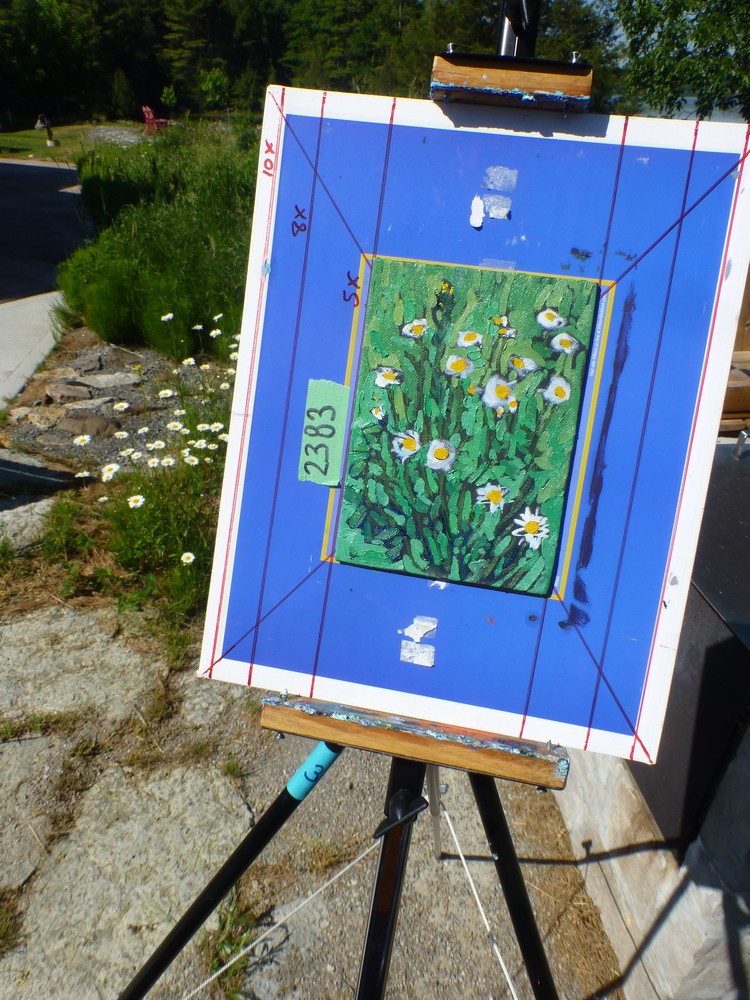
#2383 "My Daisy Garden"


I started the next painting after #2382 "A Tangle of Daisies" by simply turning to look more to the southwest. I had more daisies growing there as well. Not really a surprise. These flowers were also planted naturally. It is nice when the gardens look after themselves. The time not spent gardening left me with more time to paint. There were still no clouds in the sky. 


This small panel flowed just the way I had hoped. I used a fair bit of oil and a minimal number of brush strokes. I like it when the oils just go to where they need to go. 

For this and much more art, click on Pixels. Thank you.


Thursday, September 17, 2020

#2382 "A Tangle of Daisies"


My gardens were really planted by nature. All I do is selectively pull the plants that might not play well with the others. The daisies are bright and cheery and last for most of the summer. They may not be good forage for the creatures that share this property but they are cheerful so they get to stay. We all need some happiness to brighten our lives. Not everything must be eaten or consumed!. 

8:30 am Thursday June 18th, 2020
This particular cluster of daisies was thriving in the rocky soil along the southern face of the marble ridge. The tall stems of the plants were tangled together. Turtles had a challenge to force their way through the braided macrame forest. I made sure that there were easy ways around the daisies so that the activities of the nesting turtles were not to impeded. Sometimes I could only detect the ninja-like motions of the turtles through the swaying of the tall grasses. I was able to protect a dozen turtle nests from predators in 2020. That is par for the course. 

There was one tall yellow flower in this garden. I observed and painted it but could not put a name to the little beauty. 

For this and much more art, click on Pixels. Thank you.


Tuesday, September 15, 2020

#2381 "Trefoil Garland"


Paradise is never far away if you know where to look. There were still no clouds in sight so I simply moved the easel just a bit to the south for another view of my natural lawn. I actually started the lawn with a thorough planting of white clover as the basis. Everybody likes white clover especially the birds and the bees. I am not a fan of cutting lawns but the birds like the phoebe and bluebirds really prefer to hunt over short grass. Ticks also prefer the tall grass where the deer graze during the day. At night the deer come in to eat the clover. Bears prefer to walk on the cut grass but graze the seed heads of the taller grasses that border the lawn. So a bit of cut grass gives everyone a meal. Otherwise I plant trees. 


With time other flowers have spread into the lawn and I do not discourage that. I try to work with nature rather than vainly try to control it. I thought that this ring of flowers was kind of like a wreath decorating the rocky part of the lawn. Trefoil was the predominate flower so it became the name of the decorative garland. Apparently plants having leaves divided into three leaflets are commonly referred to as trefoil. My honey bees turned the nectar of the yellow bird's-foot trefoil into the most delicious honey. I was happy to see it bloom and flourish in the lawn. Some might consider it a weed but I see otherwise. I let nature plant our flower gardens. I believe that it is best to work with nature rather than to try to constrain the natural world into boxes. 

For this and much more art, click on Pixels. Thank you.


Sunday, September 13, 2020

#2380 "Daisy Chain Lawn"

I try to paint daisies at least once every summer. They are happy flowers. 

June 15th was a good time to start my floral series as there were no clouds in sight for at least a few days into the future. Flowers and clouds are much the same anyway. They are simple gifts from nature.
Enhance Visible Image June 15, 2020
Daisies are actually an invasive species native to Europe but they are here to stay. They arrived like the Mayflower and prospered. One might as well enjoy them rather than fight them.

Artistic Step 2380 in progress
Daisies are all through our lawn and on the marble ridges. I do not discourage them so they continue to spread - linked together in a series. There are enough flowers to weave miles of flowers into daisy chains which was the intent when the phrase that comprises the title was first used as a noun in 1841.

The meaning of a daisy chain was enhanced to describe a daisy chain of toddlers with the Baby Boom after the end of the Second World War. I was part of a daisy chain in those years. After the computer age that followed soon after the Baby Boom, the meaning of a daisy chain was modified yet again to describe an interconnection of computer devices in a series with one after another. A computer daisy chain is the equivalent of a series electrical circuit. I saw these flowers as another kind of series but connected through their roots and the soil. English is a living language and it spreads just like these flowers.

William Blake once wrote that in order "To see a world in a grain of sand And a heaven in a wild flower, Hold infinity in the palm of your hand And eternity in an hour." I feel the same way when I paint these little canvases of tiny things that many people do not even see. They may be little but are oh so powerful. We need to be better stewards of the land. Enjoy nature but leave it better than how you found it.

For this and much more art, click on Pixels. Thank you.


Thursday, September 10, 2020

#2379 "Singleton Warm Front Sunrise"

Singleton Lake was still in the cool air mass ahead of the warm front. The warm conveyor belt was surging northeastward and riding above this shallow wedge of cool air. The clouds were moving northward behind the leading deformation zone as I enjoyed my morning coffee. This confirmed that the col in the huge deformation zone was further to the south. The portion of the storm above Singleton was the cyclonic companion of the warm conveyor belt. Singleton was going to get some warm frontal rain with this one. I included some virga on the eastern horizon.

The cyclonic companion of the warm conveyor belt may be less stable than the anticyclonic companion but the stability of the warm front was still sufficient for gravity waves. An artist can never be wrong if one paints what they see. Nature easily does all of the math and is always right. The gravity waves I included in this sunrise all fit the conceptual model of the relative flow around the cyclonic swirl. The wind does indeed back with height. The brighter and fully illuminated clouds were higher that the grey clouds. Even so it can be a struggle to envision the wind field using the conceptual model.

Here are the steps that you might follow.

Knowing the direction that you are looking and relative to your location:

  • Which direction is the storm moving from? Guess from the southwest or consult the orientation of the jet stream. Answer: Southwest. 
  • Where is the highest level deformation zone of the warm conveyor belt? Answer: Well to the east. 
  • Which way are the cloud elements moving along the deformation zone? Answer: Moving northward. 
  • If the warm conveyor belt is above you, do the winds back or veer with height? Answer: Back. 
  • Instead of the previous question, use your right hand and point the fingers in the direction the cloud is moving in the free atmosphere. Is your right thumb point up or down? Answer. Up which denotes a positive cyclonic swirl. 

If you apply this to the conceptual model, this painting is under the cyclonic companion of the warm conveyor belt with the winds backing with height. The warm frontal rain was not going to miss Singleton.

For this and much more art, click on Pixels. Thank you.

This is an artistic example of the Science Tuesday post which can be found at Weather Watching Guide for Everyone….


Sunday, September 6, 2020

#2378 "Singleton Classic Cirrus Summer Sunset"

They say never use an aliteration. Sometimes the same sound at the beginning of a series of connected words can be distinctive and fun. There are no rules in art.

There was a lot of thin cirrus in the sunset sky. It told a very interesting story. That cirrus was in the warm conveyor belt of a small system and upper low near Buffalo, New York. The cirrus was banded into large gravity waves perpendicular to the southerly upper winds. These long parallel bands actually stretched from west to east.

There was a second set of  smaller gravity waves within the large waves. These smaller gravity waves revealed that the system relative wind was westerly. This is exactly the combination of winds that one would expect with the anticyclonic branch of the warm conveyor belt. Using your right hand and aligning your fingers with the system relative winds must point your fingers downward. The associated subsidence in the atmosphere explains the stable atmosphere and the abundance of gravity waves.The fact that there was not that much cloud in a moist air mass also suggested that the anticyclonic branch of the system was over Singleton. The water vapour image was the clincher to this difficult diagnosis.

The apparent divergence of the large parallel bands is a result of the crepuscular or train track effect. The large gravity waves must be parallel to each other even though our perspective from the ground suggest otherwise.

Looking at the larger scale, there was really a lot of moisture in the atmosphere. Tropical Storm Cristobal was currently active as a tropical cyclone weakening over Louisiana. Cristobal was the third named storm of the 2020 Atlantic hurricane season. It was the earliest known third named storm in the North Atlantic Ocean on record.

Weather is always exciting if we can afford the time to slow down and look up at the sky.

For this and much more art, click on Pixels. Thank you.


Friday, September 4, 2020

#2377 "Circular Thunderstorms"

My Mother-in-law used to insist that thunderstorms would circle around to come at you again. As if individual cumulonimbus clouds were sentient beings that knew exactly where you in particular lived. Further more, these circling storms had intent on raining on your parade. I always smiled. Once does not discuss meteorology with your Mother-in-law. Even as a severe weather meteorologist who specialized in such things, you knew you had to lose any such discussion. I try to never argue. No one wins those debates either - even if you are right and they are wrong. Better to just smile. You are unlikely to change the world anyway. Convection tends to be circular in space but they definitely do not circle around to come back at you again in time.

This was the second row of thunderstorms of the afternoon of the anniversary of D-Day. They were not as vigourous as the first round as is quite typical in these multiple lines of convection. There was still some mammatus formation in the underside of the back anvil but even that was less pronounced. I painted what I saw.

There was a third line of convection as well and these cells were weaker still. Weather is fun and I always tried to humour my Mother-in-law. She was a fine lady and we had fun!

For this and much more art, click on Pixels. Thank you.


Thursday, September 3, 2020

#2376 "Singleton Mammatus"

The heavy rain and strong winds painted in #2375 "Fire and Rain Coming" had swept south of Singleton. The time of that painting was 2:30 pm on Saturday June 6th. This view of the back side of the thunderstorm under the anvil was from an hour later.
The mammatus was more dramatic than what I usually see associated with most storms. Mammatus clouds certainly do look ominous and they do have a story to tell. Here is that tale.

Mammatus cloud are also called simply mamma or mammatocumulus. They are cellular pouches that hang under the base of a cloud. Typically this cloud is the anvil of a thunderstorm also known as a cumulonimbus. Mammatus result from the sinking of moist air into dry air. Some people think of mammatus as upside-down clouds.

Mammatus are rare for clouds in that they actually are sinking in the atmosphere. Most clouds are formed in ascending air. The pouches of cloud must be cooler than the surrounding air in order to descend in the atmosphere. The longest living and thus dramatic mammatus clouds like those I painted are comprised of large drops and snow crystals. These larger particles require greater amounts of energy for evaporation into oblivion to occur. The water droplets or snow flakes warm as they fall into higher pressures within the cold mammatus pouch. Simultaneously, the smaller particles will get to a point were they will evapourate or sublimate into water vapour. This vapourization process takes energy and cools the air in the descending pouch. The balance of subsidence warming and evapourative cooling means that these descending pouches of droplets or flakes will sink slowly. They will continue to do so but at a slower rate until the particles are all turned into water vapour and the mammatus cloud is no more.

Mammatus clouds are not an indication of severe weather or tornadoes. Thunderstorms do send moisture aloft into their anvil and the stronger the updraft, the more moisture will comprise that shelf of cloud aloft. What goes up must also come down. Large particles dropping into dry air are the mammatus pouches coming down. They are beautiful and to correspond typically with a strong thunderstorm updraft but that storm is not necessarily severe. Supercell thunderstorms are the severe type of convection and they also require the ingredient of wind shear but we will not get into that today.

For this and much more art, click on Pixels. Thank you.

#3023 "Next Adventure at Parry Sound" Part Two

#3023 "Next Adventure at Parry Sound" 20 X 24 inches, oils on canvas. Started at 9:15 am, Wednesday, June 24th, 2026 There is noth...